
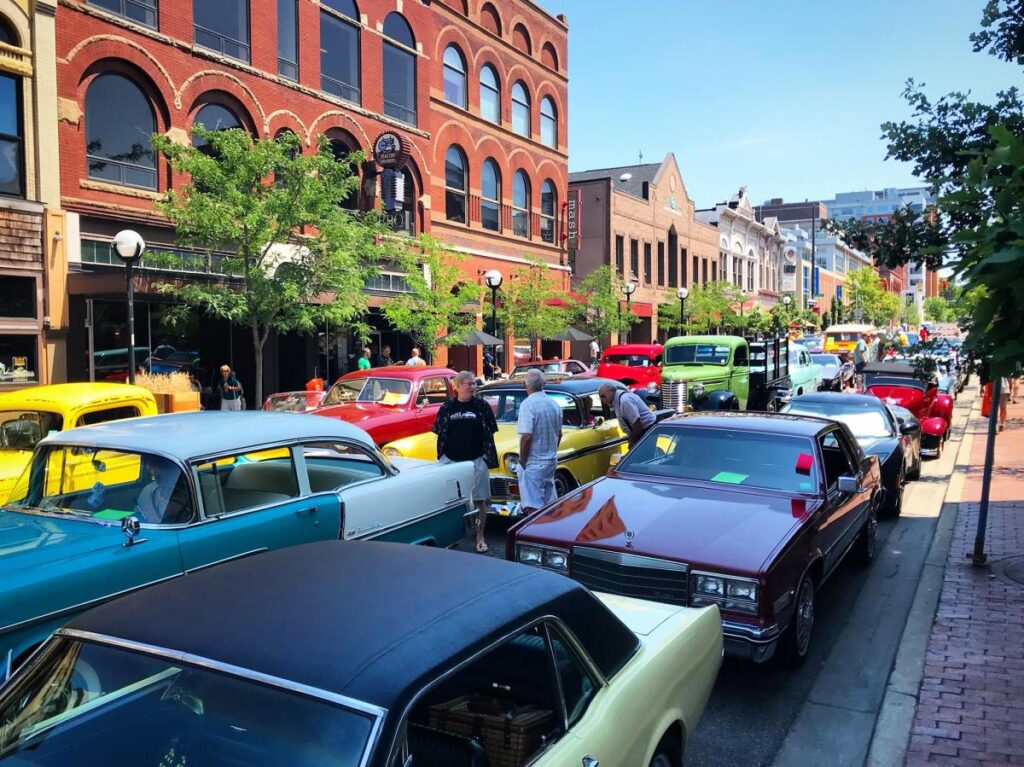


Every year, during the hottest days of Michigan summer, Ann Arbor hosts the Rolling Sculpture Car Show. It’s held downtown soon after the distinguished Ann Arbor Art Show leaves town. That Rolling Sculpture label seems a bit haughty to describe streets filled with muscle cars, college girls in short shorts, and spectators drinking out of plastic cups. Seems more like a Michigan tailgate party than an art exhibit to me.
Sure, there’s lots of chrome and custom paint on display. There’s also a classic rock band playing amongst the smell of fresh gas and occasional sound of loud exhaust pipes. That’s part of the car show culture, in my opinion.
But I’m not qualified to judge art exhibits, car shows, or fine wines. As Dirty Harry said in Magnum Force, “A man’s got to know his limitations.” Confucius couldn’t have said it better . I know what I like when I see it, and it’s usually not the critic’s choice.

For example, my BB King skateboard wall art, Bob Marley clock, and photos of graveyard cars won’t win any awards but I dig’m enough to hang them on my office wall.
My question – is a car show really art? Where did the Rolling Sculpture name come from? Best to investigate a bit deeper using my second brain, Google. Apparently, the Rolling Sculpture definition applies to cars designed and built during the Art Deco Era.
Art Deco was an architectural style during the early decades of the 1900’s through WWII. Cars were designed emphasizing smooth, sleek, aerodynamic forms.

Like the Delahaye example, these cars typically had swooping fenders, long hoods, and curved surfaces. They projected a sense of speed and motion even when parked. Very Cool…
Is it art? I have to say, “yes, of course it is.” When you consider the design and craftsmanship involved, it’s an example of fine art that has withstood the test of time. And automotive designers continued to be inspired by the Art Deco period through the 1950’s & 1960’s.
Anyhow, I was committed to going to the show and displaying my recently acquired ’69 Mustang convertible. Even copped a spot on Main Street.

It was an impressive scene, with streets downtown blocked off, live music, and most of the restaurants serving food and beverages on the sidewalks. Tons of classic cars and people hanging out on a hot Friday evening, gawking at their favorite rides and sharing stories of their mis-spent youth.
There weren’t any Bugattis or Delahayes at the Ann Arbor Rolling Sculpture car show. Being extremely rare and valuable, they’re owned by wealthy private collectors and only displayed at elite shows like the Concours d’Elegance. And when you see those cars, it’s like viewing a rare, extraordinary display of art.
Now it begins to make sense and it’s fair to say that cars designed after the Art Deco phase qualify as rolling sculptures, too. The styles, materials, and aesthetics changed over time, but these vintage rides still attract and inspire people on the street. Art meets engineering, and the examples are staged like steel sculptures on Main Street.
Every car show is a rolling museum of speed, craftsmanship, and the enduring love affair between people and their cars. Turn the key in the ignition, drop it in gear, and art rolls to life on the boulevard. These cars form a connection with the people on the street.
Beyond the gleaming bodies, chrome wheels and high-powered motors, spectators appreciate the dedication and effort owners have made to keep these machines road worthy. Just seeing these cars brings back memories from the past and gives younger people something to dream about.
There were too many cars to mention in this blog, but I have to point out a few that absolutely qualify as “rolling sculptures.” The first is a 1949 Mercury, owned by Ken and Linda. After a couple of decades of off and on restoration work, this car was finally restored to its original glory in late 2024. No, it’s better than original, with custom mods to improve the look. Check out the lowered body and sleek lines on this classic beauty, Linda included.

The ‘49 Mercury was made famous when James Dean drove it in the Rebel Without a Cause movie. The car was slightly modified with a lowered suspension, de-chromed exterior, and a black gloss paint job to fit the renegade youth who drove it.
A 1956 Chevrolet Bel Air known as the “Bumble Bee” was parked on Main Street. 
The crocus yellow paint with an onyx black top was a factory option for 1956 Chevys. I first saw this car in the parking lot at my dentist’s office and met the owners in the waiting room. They were very active in local car shows for many years. Sadly, the husband recently passed and Bumble Bee is going to a new owner who is committed to preserving her. RIP my friend. The legacy lives on.
I met Randy, the owner of this 1960 Ford Thunderbird. There’s a long history of this car. It originally sold new for $4721 and had been stored for 15 years before the previous owner started to refurbish it. He never finished beyond getting it rough primered. Randy took this on in 1998, including part time hand buffing the body over two years.

In 2000, he started a phased retirement and by 2003 he had the TBird repainted and the interior refurbished where needed. The 352 motor and leather interior are primarily original.
Every year, Randy and his wife take the TBird on the U.S. Old 27 Motor Tour that starts in Coldwater, Michigan. US 27 was the North South equivalent of Route 66. About 1500 cars sign up for the trip which takes place over 6 days and 5 nights. Sounds like the perfect road trip to me. Click on the link above for more info.

There were probably 200 cars at the Rolling Sculpture Car Show this year. Too many great cars and stories to cover here but check these 3 cars out. A very nice 1963 Ford Galaxie 500, a 1960 Lincoln Continental, and a 1949 Buick.

Fine art doesn’t just hang in museums or my office wall. Sometimes, it rolls on four wheels and smells like high octane gas! Get out and support your local car shows!

Note: Featured photo at top of page from AnnArbor.org 2025 Rolling Sculpture web site.